Why a Hollow Holds the Morning Mist
Why a hollow holds the morning mist depends on cool air, damp ground, and shelter. Learn what to watch so you can read a lingering patch in context.
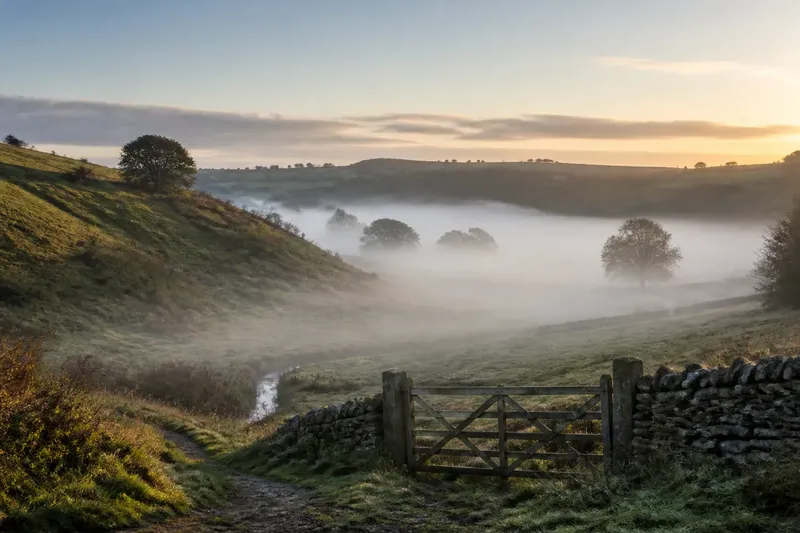
A hollow can stay veiled in morning mist after the slope above it has cleared. Why a hollow holds the morning mist comes down to where cool air settles, how much moisture is nearby, and whether moving air can disperse it. Read those signs together, and the pale patch becomes a clue about the land rather than a forecast in miniature.
The shape of the ground helps collect cool air
On a calm night, the ground loses heat to the open sky, cooling the air close to it. Cool air is denser than warmer air, so it tends to drain downhill and collect in low places, though it does not follow a channel as neatly as water.
A hollow can gather a shallow layer of cool air. If that air cools enough for its water vapor to condense, tiny droplets become visible as mist. A nearby rise may stay clear because air there is less pooled, more exposed to mixing, or simply not as cool.
Look for a bowl-like dip, a valley floor, or a shallow basin between rounded fields. Even a gentle fold can shelter air from the movement that would disperse it. Compare the hollow floor with both sides, not just with the nearest hilltop.
Wind, damp ground, and cloud cover change the pattern
Several conditions can produce mist in a hollow, and they do not all point to the same kind of morning. Start with what you can see rather than treating every pale valley as evidence of one fixed weather pattern.
A still hollow with clear slopes
This pattern fits pooled cool air, especially after a quiet night when the ground has had time to cool. The hollow gives that air somewhere to collect, while the more exposed slope mixes more readily with air above it.
Sunlight may warm the ground and help the mist thin at its edges. A breeze can also break it up, although a sheltered hollow may stay calm while the slope feels breezy.
Wet ground after rain or a damp spell
Moist soil, grass, ditches, and shallow water can supply vapor to the air near the surface. If that air cools enough, condensation becomes more likely. The hollow can retain cool air, while damp ground supplies some of the moisture that becomes visible.
Notice whether the mist follows wet patches or fills the low ground more broadly. A strip above a stream or waterlogged field may stand out, but moisture alone does not explain every patch: cooling and air movement still matter.
Mist across several fields and slopes
A broad sheet of haze is less likely to come from one small hollow alone. The low ground may still hold denser or longer-lasting mist, but moisture and cooling are affecting a wider area. Compare exposed ridges, open fields, and the valley floor to see whether the hollow is a persistent pocket within that broader layer.
A breeze crossing the hollow
Moving air often mixes a shallow cool layer with warmer air above, thinning or displacing mist. A hedge, bank, or bend in the valley can alter local airflow, so the wind at the road may not describe conditions on the hollow floor.
A ragged edge that shifts suggests movement; a steady patch in a protected dip suggests that the low ground remains calm. Neither sign settles the cause on its own.
Read the edge and compare fixed landmarks
If the mist boundary follows the contour of a low basin, the land may be helping retain cool air. If it crosses slopes without much regard for the terrain, a broader layer or passing bank may be involved.
Choose a fixed tree, gate, or bend in the path and check how clearly it shows through after a pause. If more of the landmark appears and the mist thins or separates into patches, it is clearing locally. If the edge shifts across the ground while the landmark remains similarly veiled, the mist may be moving rather than lifting.
A stationary-looking patch can still change slowly; the eye is not famous for noticing gradual motion while admiring a view. Keep to a safe route, and do not treat poor visibility as a reason to leave a path or approach a road edge.
Compare nearby hollows before drawing a conclusion
One hollow offers limited evidence. A safe walk from the floor to a higher shoulder can show whether mist depth changes with elevation and whether similar dips nearby show the same pattern. Skip that comparison if visibility makes the route uncertain.
Imagine you reach a shallow valley after a quiet night. The grassy floor is misty, the near slope is clear, and the ground beside a small stream is damp. You use a familiar gate as a reference, pause, and then see more of the gate as the mist edge retreats toward the stream in strengthening light. The reasonable reading is that low, cool air and local moisture are contributing while warming is beginning to thin the mist; that scene alone does not support a precise forecast.
If several low spots hold mist while the rises between them clear, terrain is likely part of the explanation. If only one corner remains veiled, local shelter or moisture may matter more than the valley shape as a whole.
How can you tell whether the mist is lifting?
Use this short scan at a fixed viewpoint. Each observation leads to a practical distinction, not a promise about what the weather will do next.
- Check a fixed tree, gate, or sign; if more of it becomes visible, treat the change as local thinning, then keep watching before deciding the whole hollow is clear. If visibility stays the same, compare the mist edge instead.
- Check whether the mist becomes thinner or breaks into separate patches; if it does, read that as local clearing, then compare another part of the hollow. If it stays evenly dense, look for movement rather than assuming it is lifting.
- Check whether the edge advances across the ground; if it shifts while landmarks remain similarly veiled, treat the patch as moving and wait for another comparison. If the edge stays put, look for changes in landmark visibility.
- Check whether the edge follows the hollow floor; if it does, terrain may be retaining the mist, so compare a nearby rise. If it crosses the slope freely, consider a broader or passing layer and avoid attributing it to the hollow alone.
- Check whether a breeze is stirring the patch; if the edge breaks or shifts with the airflow, allow for mixing or displacement. If the hollow remains sheltered and still, continue observing the low ground rather than using wind at the road as a substitute.
- Check whether the scene is becoming easier to see along your safe route; if visibility improves, continue cautiously and reassess as you go. If it worsens or makes the route uncertain, stop the comparison and return by a familiar safe path.
What does mist in a hollow tell you?
Does a hollow always hold mist longer?
No. A hollow can favor pooling, but wind, cloud cover, surface moisture, and surrounding terrain all affect what happens. An exposed depression may clear quickly, while a sheltered low patch may retain mist.
Why can a slope clear while the valley floor stays white?
Cool air can drain toward the floor and remain there when conditions are calm. The slope may receive more mixing or warm sooner, allowing droplets to evaporate while the low layer persists.
Does mist in a hollow mean rain is coming?
Not by itself. Mist indicates that water vapor has condensed near the surface, but that local condition does not establish what the wider weather will do. Use a reliable forecast when planning around changing or hazardous conditions.
Can a moving patch look as if it is lifting?
Yes. A drifting edge can uncover one landmark while leaving the mist nearby unchanged. Compare a fixed landmark with the patch’s boundary before deciding that the whole hollow is clearing.
Let the hollow explain only what it can
The useful conclusion is modest: low ground can collect cool air, and damp surroundings can supply moisture, so a hollow may keep mist after adjacent slopes clear. The pattern is more plausible when the night has been calm and the hollow is sheltered, but no visible feature settles the cause on its own.
Remember the same hollow under different conditions. One morning it may be filled, another clear, and a third streaked beside a stream. Why a hollow holds the morning mist is easier to read when you compare the ground, the air, and the changing edge—and note which part of the landscape clears first.