The Cloud Shape That Does Not Tell the Whole Story
Cloud shape can hint at changing weather, but it cannot account for wind, terrain, or passing showers. Learn what to check before choosing your route.
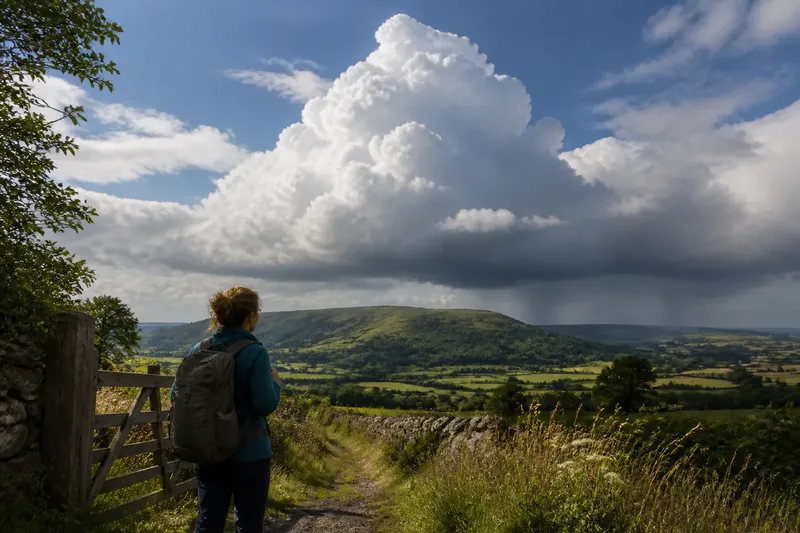
A bright, cauliflower-shaped cloud over a field can look like a forecast in progress. Cloud shape is a useful weather sign, but it cannot show what the wind is doing above the cloud, what is building beyond the ridge, or whether local air is changing by the minute.
Read the cloud as one part of a moving scene. These six checks help separate a suggestive outline from a sensible decision about the walk.
Watch whether the cloud is growing
A compact, puffy cumulus cloud often forms as warm air rises and cools. If its top stays rounded and its edges remain distinct, it may simply mark daytime heating. Continued upward growth, especially with a broader, darker base, shows that the cloud is developing; it does not establish what will happen next.
Compare its shape after a short stretch of walking. A small puff that looks much the same offers a different signal from one that is rising and spreading.
Compare the breeze with cloud movement
The wind at your face may not move at the same speed or from the same direction as the air carrying clouds. A grass seed head or hedgerow shows the low breeze; cloud movement gives a view of air higher up. If they disagree, keep both observations rather than choosing the more dramatic one.
Notice whether clouds move steadily, slow, or seem to travel in different directions at different heights. A change in wind can shift the path of showers even while a familiar cloud shape remains overhead.
Look for spreading and thinning
Separate puffs may rise and enlarge until their edges merge into a broader layer. High, thin cloud can also spread across the sky and soften the sunlight without immediately bringing rain. These changes describe different patterns, but neither supplies a timetable.
Look at texture and depth. A sharply rising turret differs from a flat gray patch, while a veil gradually covering the blue is changing across a wider area. Ask what the sky is becoming, not only what it resembles.
Use the landscape as part of the view
Hills, wooded slopes, coastlines, and open fields affect how air moves and where it rises. A cloud over a ridge may reflect air lifted by terrain, while a shower beyond a hill can remain hidden from a lane below. Clear sky overhead does not describe the whole horizon.
At a change in terrain, look back and ahead as well as upward. Clouds gathering over one slope may leave the next valley bright; one field is a poor weather report for the whole parish.
Treat a dark base as a prompt to check
A dark underside can mean a cloud is thick enough to block more light. It does not tell you how much rain is falling, how far the cloud extends, or whether it is moving toward you. A passing shadow can also dim a field without rain reaching the ground.
Look for a visible rain shaft or curtain beneath the cloud, and notice whether showers are already crossing nearby ground. Distant thunder is a reason to take conditions seriously, not a way to estimate how close a storm is. For severe-weather decisions, check a current local forecast and follow relevant safety guidance; visual signs are not a substitute.
Recheck the sky as the walk continues
Weather is a sequence, not a still image. A cloud may change shape, merge with another, or pass without bringing the weather its outline seemed to promise. A fresh view from another stretch of track is more useful than carrying one judgment for the rest of the walk.
Say you are beside an open pasture and see a tall, bright-topped cloud above the far ridge. You pause where the lane opens, observe that its top is still growing, and feel a fresh breeze across the field; you then choose a sheltered route and check a current local forecast before continuing. The observable result is a route choice based on changing conditions, not a claim that rain is certain.
Use this checklist to choose what to do next
- Check whether the cloud top is growing; if it is, keep watching the sky and consider a route with nearby shelter, but if it is holding its shape, continue checking other signs.
- Check whether the cloud’s base is broadening or darkening; if it is, look for rain beneath it and check the local forecast, but if it is not, do not treat the outline alone as a warning.
- Check grass, seed heads, or hedgerow leaves for the ground-level breeze; if the breeze is freshening or shifting, reassess the exposed route, but if it is steady, compare it with cloud movement before deciding.
- Check whether clouds are moving differently from the breeze; if they are, allow for changing conditions higher up and keep to a route with an easy way back, but if they are not, continue observing for other changes.
- Check the horizon beyond the next ridge; if rain curtains or a dark, advancing cloud are visible, shorten the walk or seek suitable shelter, but if the view is clear, remember that terrain can still conceal showers.
- Check for thunder or other signs of severe weather; if they occur, follow current local safety guidance and seek appropriate shelter, but if they do not, do not use their absence as proof that conditions are safe.
What can cloud shape tell you?
Does a tall cloud always mean a storm?
No. A tall cloud shows vertical development, but that alone does not establish whether a storm will form. Continued growth, surrounding clouds, and changing wind add context.
Do dark clouds always bring rain?
No. A dark underside can come from a thick cloud blocking sunlight, and the cloud may pass without rain reaching your location. Look for precipitation beneath it and watch its movement.
Why can clouds move one way while the wind feels different?
Wind speed and direction can vary with height, so clouds may move differently from the breeze near the ground. The mismatch means each observation describes a different layer of air.
Can cloud shape predict the weather for the whole day?
Not reliably on its own. Clouds change as wind, air, and terrain interact, so a brief observation gives only a partial view. Check a current local weather service for plans that depend on the forecast.
Cloud shape is a useful weather sign when read alongside movement, wind, and place. On your next countryside walk, note the cloud’s change and the condition of the horizon; if either shifts, revisit your route decision rather than asking one silhouette to settle the matter.