A Winter Lane Walk for Listening
A winter lane walk for listening offers three simple ways to notice sound, compare sheltered and open places, and pay closer attention without special gear.
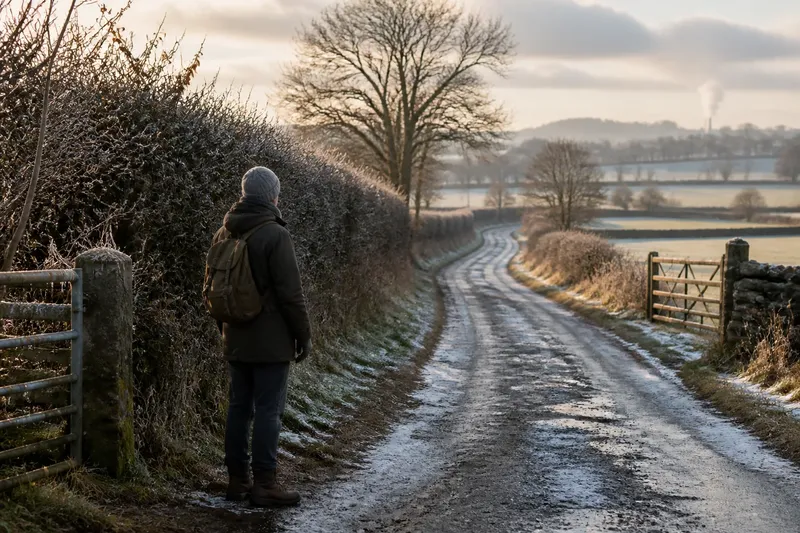
A winter lane walk for listening is easier to shape when you choose a familiar public route with safe places to pause. Bare branches and cold air may make small sounds easier to notice, but the aim is not to identify every bird or guess what lies beyond the hedge. Listen instead for how sound changes with distance, shelter and your own position.
Three approaches work well: pause at three points to sort nearby and distant sounds, follow one sound along the lane, or compare a sheltered place with an open one. Each gives you something specific to notice without turning a quiet walk into an examination.
Use three pauses to sort nearby and distant sounds
At three safe points along the same lane, listen first for sounds close to you, then for sounds farther away, and finally for the broad background that remains when individual noises fade from attention. Nearby sounds might include a boot brushing grit, water ticking from a gate or a twig tapping a branch.
Distant sounds could include a dog, traffic beyond the fields or a farm machine whose location is unclear. Background sound is not necessarily silence; wind in bare hedges or a low wash of road noise may fill it.
Stand clear of gateways and traffic, let your breathing settle and avoid talking until you have noticed the first few layers. Note a sound’s direction and character before trying to name it.
At each stop, ask what is closest, what seems farther away and what continues underneath.
Follow one sound as it changes along the lane
Begin with a sound that is already present: wind moving through ash trees, a stream beside the road or traffic audible beyond a rise. Walk at an easy pace and notice whether it grows, softens or changes texture as the lane bends or the hedge thickens.
A louder sound is not necessarily closer. A low wall may reflect noise, while a gap in a hedge may let it through; a bend can hide a source without removing the sound. The useful observation is the change itself, not a confident story about its cause.
Say you hear a steady rush somewhere beyond a field entrance. You continue along the lane and pause where a tall hedge gives way to a low bank; the rush becomes clearer, then softens after the bend. That sequence suggests the opening and bend may affect what reaches you, while leaving the source unresolved.
Choose one sound to follow, but let it go when another becomes more interesting.
Compare a sheltered stop with an open one
Pause beside a thick hedge, then at an open stretch or field gate, always standing safely away from vehicles and farm activity. Notice what becomes clearer, what fades and whether the balance between close and distant sounds shifts.
A hedge can soften some noises and make others seem more prominent by contrast. An open stretch may expose you to wind, which can mask quiet sounds or buffet your ears. A wall, ditch or bank can also affect what you hear, depending on the lane and the conditions.
This comparison is useful when the weather is unsettled: a sheltered stop and an exposed stop may feel different even on the same short walk. Do not treat the contrast as a verdict on the landscape; wind, traffic, an animal or several things at once may account for it.
Choose a listening approach by what you can observe
Pick the approach that matches the route and the question you want to follow. These concrete checks help turn a preference into an action and a decision.
- Three pauses: If the route has three safe places to stand and you want a repeatable pattern, stop at each and note the closest sound, a farther sound and the background; if safe stopping places are scarce, use only the safe points available rather than stepping into a gateway or roadway.
- Follow one sound: If a continuous or recurring sound is audible from the lane, note its character and direction, then listen again after the next bend; if it disappears or traffic makes it hard to follow, switch to a nearby sound or stop tracking it.
- Compare two settings: If the route offers a sheltered hedge and a safely accessible open stretch, listen at both and note what becomes clearer or quieter; if the open stretch is exposed to traffic or farm activity, skip it and compare two safe sheltered spots instead.
- Account for wind: If gusts buffet your ears or mask quieter sounds, move to a sheltered place and listen again; if the sound remains obscured, make wind the observation rather than straining to hear.
- Account for traffic: If passing vehicles interrupt the quieter sounds, wait from a safe position for a natural gap; if traffic remains dominant, notice its rise and fade or choose another route.
- Keep the route accessible: If signs permit walking and there is room to stand clear, continue on the public lane or path; if access is unclear or a field entrance is private, stay on the permitted route and follow local signs.
Imagine you begin with a hypothetical lane that has a thick hedge, a safe open verge and traffic audible beyond the fields. First, you pause beside the hedge and hear close drips and a broad wash of traffic; next, you walk to the open verge and find that wind masks the drips; then you notice the traffic swelling and fading during a natural gap. The resulting choice is to compare the hedge with another sheltered point, rather than treat the windy verge as a useful test of distant sounds.
You can combine approaches, but there is little need to do all three every time. A short walk with two attentive pauses may be more satisfying than a longer route filled with dutiful stopping.
What should you listen for on a winter lane walk?
How can I tell a nearby sound from a distant one?
Nearby sounds often have sharper detail, such as footsteps on gravel or a close drip from a gate. Distant sounds may seem softer, but wind, barriers and echoes can blur the distinction, so treat distance as an impression rather than a certainty.
Should I try to identify every bird or machine?
No. Start by noticing whether a sound is continuous or intermittent, high or low, steady or changing. Naming it can be satisfying, but listening remains useful when the source stays out of sight.
What if traffic overwhelms the quieter sounds?
Wait for a natural gap if one comes, or choose a sheltered section where road noise is less prominent. If traffic remains dominant, notice its rise and fade rather than treating the walk as a failed listening session.
How long should I pause?
Pause long enough to hear more than the first obvious noise, then move on when you are ready. A stop should remain comfortable and safe, not become a contest in stillness.
Carry the same listening habit to the next walk
A winter lane walk for listening needs no notebook or app. If you want to remember the route, jot down a brief contrast afterward: “hedge side, close drips; open bend, wind and distant road.” That makes the next visit a comparison rather than a replay.
Keep one useful question for the next winter lane walk for listening: which part of the route changed what you could hear? The answer may be a hedge, a bend or simply the wind turning while you stood still. Note the place and the sound, and you will have a specific starting point for another walk.