Hedge, Wall or Fence: Reading a Field Boundary
Read a field boundary by its shape, materials and repairs, and distinguish visible features from guesses about how a hedge, wall or fence was made.
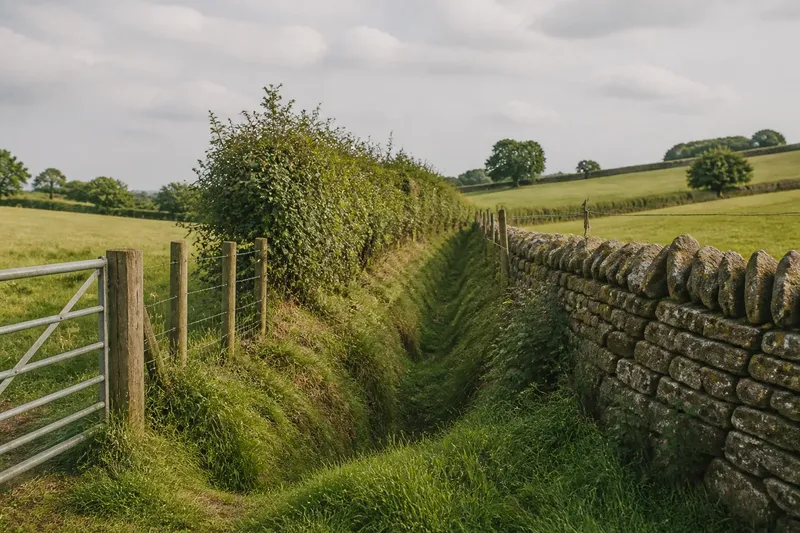
A field boundary often shows how it was made before you get close enough to see its details. To read a field boundary, inspect its outline, materials and repairs: a raised green bank, a stacked stone face and a taut wire line each leave a different signature across the landscape.
A hedge reveals growth and maintenance
A hedge is a living boundary, shaped by repeated cutting, growth and gaps filled over time. Its outline may be broad at the base and narrow above, or rise as a ragged strip of shrubs and young trees. Those differences suggest how the plants have been managed, though they do not provide a complete record of the field’s history.
Look for variation along its length. A dense section beside a bare opening may mark a change in maintenance, an old entrance or a spot where plants failed to take. Hawthorn, blackthorn, hazel and bramble can mingle; the mix varies with local conditions and planting choices.
Some hedges stand on a bank, sometimes with a ditch alongside. The bank lifts the boundary above the surrounding ground, while a ditch can make the edge more distinct and carry water away. Where hedge and earthwork meet, the field line is a constructed strip of ground, not merely a row of plants.
A dry-stone wall has a stacked profile
A dry-stone wall is held together by the fit and weight of stones rather than visible mortar. Its sides may slope slightly inward, with large stones near the base and smaller pieces packed into the core. A neat cap of upright or broad stones can finish the top, though local building habits and available rock produce plenty of variation.
Watch the wall’s profile. A bulge, a dip or a patch of smaller, differently colored stone may indicate repair or collapse, not necessarily a different original design. Lichen, weathering and plants rooted in joints soften the surface, but the repeating courses and stacked faces usually remain legible.
A bank faced with stone can look similar from a distance. An earth core, a ditch or a change in how the stones sit may distinguish it from a freestanding wall. If the boundary is overgrown, “stone-faced edge” may be a more accurate description than a confident claim about its construction.
A fence shows its structure clearly
A fence makes its structure unusually easy to inspect: posts, rails, wire, mesh or boards form a visible line. Materials often indicate the kind of enclosure being maintained, but they do not explain when it was installed or what it replaced. A newer-looking fence may follow a much older field line.
Notice how posts meet the ground and how the line changes direction. Closely spaced supports, a heavier corner post or a braced section can show where tension and turns are managed. A gate interrupts the run and may preserve an access route even when the surrounding edge has changed.
Wire may run beside a hedge or along the top of a wall. In that case, the fence is an added layer, not necessarily the whole boundary. A narrow strip between the wire and the field may contain a ditch, a bank or simply accumulated growth.
Use these observations to read a field boundary
At each point, record what is visible before deciding what it might mean. The observation supports a practical next question; it does not turn a plausible explanation into a fact.
- Check whether a hedge sits on a raised bank. If plants and earth form one continuous strip, then note a hedge-and-bank boundary; if the ground stays level, then describe a hedge without assuming an earthwork.
- Check for a ditch beside the boundary. If a channel is visible, then note its position and whether it follows the edge; if there is no visible channel, then leave drainage out of the description.
- Check whether stones form repeated courses with a stable face. If they do, then describe a stacked stone wall; if earth shows through or stones appear to face a mound, then use “stone-faced bank” as the more cautious reading.
- Check for visible mortar between stones. If mortar is absent and the stones fit by weight and placement, then dry-stone construction is plausible; if mortar is present or the joints are obscured, then describe the visible masonry without naming its method.
- Check whether posts, wire, rails, mesh or boards make a separate continuous line. If they do, then record a fence as one boundary layer; if the line is broken or hidden, then note the surviving sections rather than treating it as continuous.
- Check for a gap, gate or change in direction. If an opening aligns with a track or access point, then note that connection; if no route is apparent, then record the opening without assigning it a purpose.
- Check for a repair that differs in material or shape from the adjoining edge. If a distinct patch is visible, then note the contrast as a repair or possible repair; if the difference is subtle, then describe the materials without deciding when or why they changed.
Mixed materials usually show adaptation
Mixed boundaries often record adaptation rather than a single deliberate design. A hedge can grow over an earth bank; a wall can acquire wire where a higher barrier is needed; a fence can be added to a hedge with gaps. Each layer may serve a different practical purpose, and the visible result reflects successive choices.
Say you encounter a low stone wall with wire fixed along its top and shrubs rooted behind it. You note the wall’s stacked stones, the separate wire line and the plants along the rear edge; you then describe the boundary as a wall with added fencing and hedge growth, while leaving the order and dates of construction unresolved. That account preserves what is observable without pretending the materials provide a complete history.
Follow a short stretch rather than judging from one point. See whether the same combination continues, where it changes, and whether entrances or drainage features help explain the layout. Keep to the path and avoid handling walls or reaching through fences.
Questions about reading a field boundary?
Does the boundary follow the shape of the land?
A line that bends around a hollow, ridge or wet patch may reflect the ground as much as a property division. Compare its course with nearby slopes and drainage, without assuming that every bend has a natural cause.
What do repairs reveal?
Repairs show where the edge has needed attention: a plugged hedge gap, a rebuilt wall section or replacement fence posts may stand out from older material. They reveal maintenance, but rarely tell you who did it or exactly when.
Can one boundary type identify the age of a field?
No single hedge, wall or fence is a reliable date stamp. Materials can be replaced while a boundary line remains, and styles vary from place to place; age is better treated as a question than a conclusion based on appearance alone.
How should you compare two neighboring edges?
Notice differences in height, width, material and access points, then ask what each edge does differently. One may contain a dense hedge and ditch, while another uses a simple fence; the contrast is observable even when its cause is not.
Keep observation separate from inference
Separate what you can see from what you infer. “Three wire strands on weathered posts” is an observation; “this replaced a hedge” is a possibility that needs more evidence. The distinction keeps a walk attentive without turning every stone or gap into a story.
Use field boundary as a prompt to inspect form rather than assign a history. Trace the line with your eyes, note changes in materials, and look for the ground features that accompany it. A hedge, wall or fence is most informative where its construction becomes visible: at a corner, a gap, a repair or the point where one form gives way to another.
On your next walk, choose one boundary and follow its changes from a safe path. A useful final note names both the feature and the uncertainty: “stone-faced bank, wire fence above; construction order unclear” is more informative than a confident story the landscape has not supplied.